


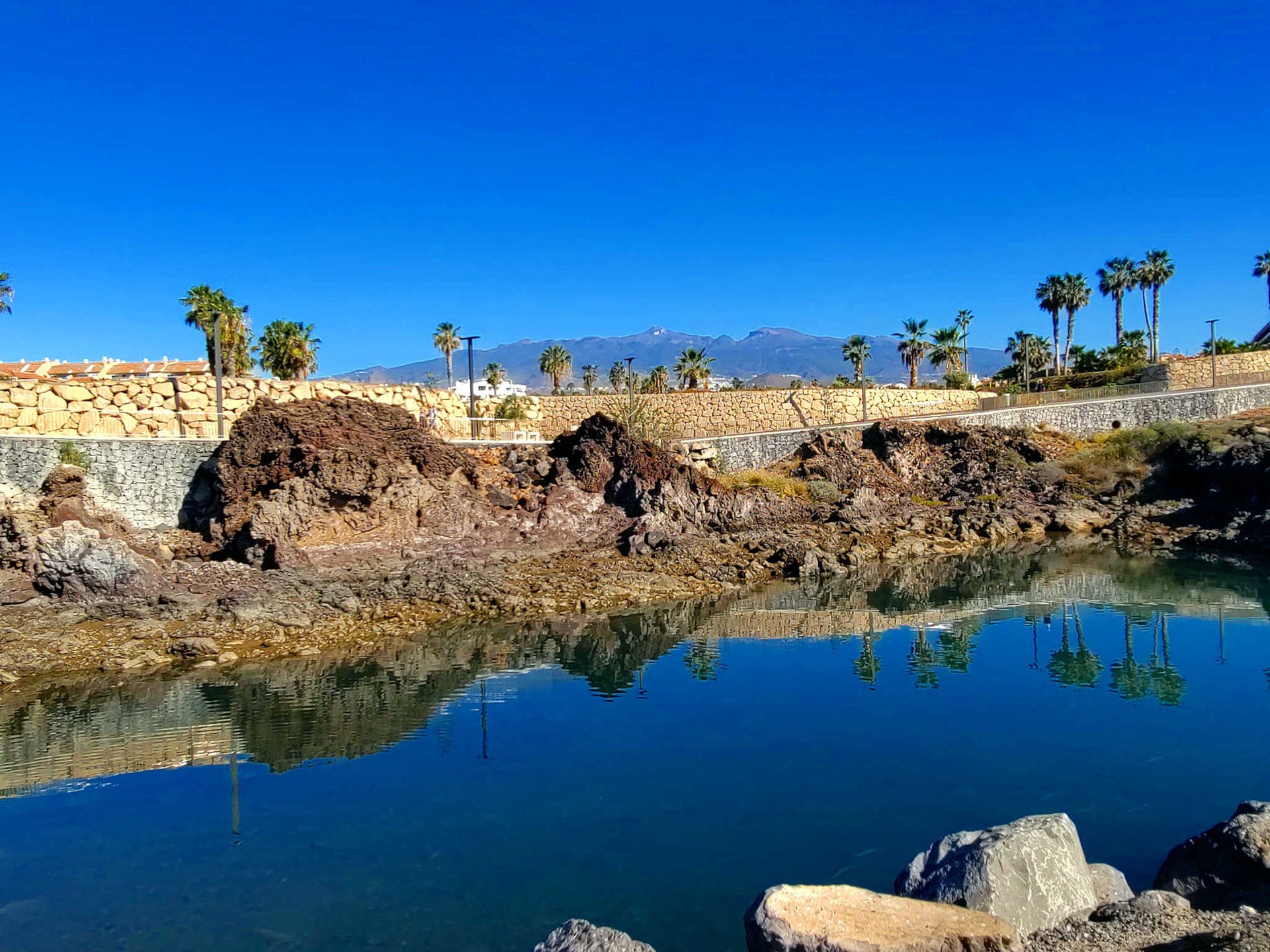
Kanaren - Teneriffa
The Travel
Travelogue Canary Islands - Tenerife
Arrival at Tenerife del Sur Airport on Friday lunchtime. The luggage has arrived in full, which is not a matter of course at a failed airport like BER, and unlike at the latter airport, the trolley is in my hands after a quarter of an hour. BER will need 80 minutes for the return flight. But you only have to want to get in touch with this airport to make a complaint and then nothing will surprise you. But that's a completely different story.
Prologue - Getting there
There is plenty of time, the crew will not arrive until the evening. The coach park offers the whole range of tour operators who take tourists to their bed castles, but I can't find a local bus connection at first glance. Seven kilometres on foot, no problem, so I set off.
The initially tarmac road turns into a volcanic gravel track and the trolley groans over the many stones. To make matters worse, the path marked in the navigation programme is not there - instead, the landing zone for the planes is fenced off. I add a few hundred metres to my planned route. It goes down a slope, but I can balance along the one metre wide edge with the trolley. The aeroplane is approaching directly towards me. A nice sight. After this diversions, however, I reach my destination, where I can fortify myself.
I try to get to my hostel by bus. Unfortunately, it's just a residential and holiday estate. Something is wrong. So I check again and lo and behold, the hostel is exactly where I got on the bus. What a superfluous action, which also cost me my wedding bracelet. I had already lost it briefly on the journey to the Aeolian Islands due to the clasp being damaged, and now it's gone for good. The journey could have got off to a better start.
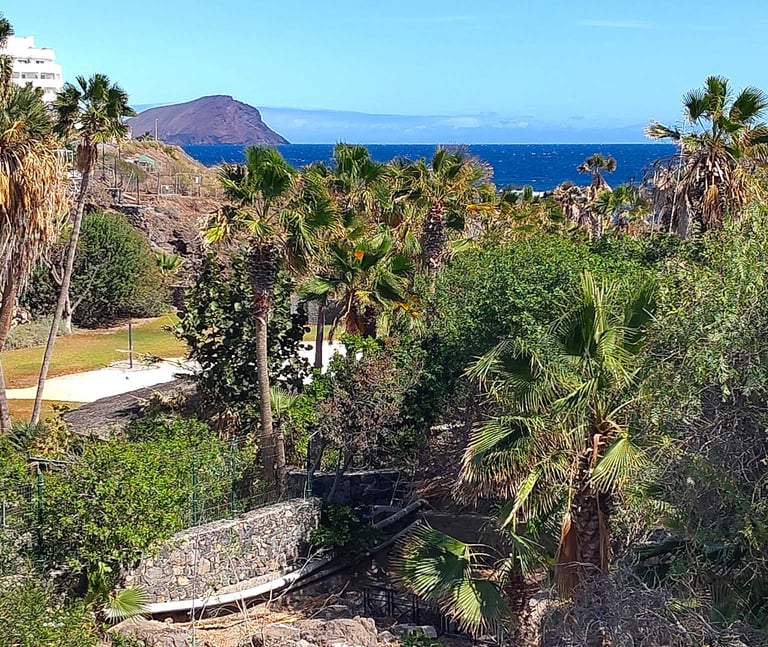
In the evening we go to the crew meeting. From my very ordinary Canarian town, I head into the centre of the tourist retort facilities. I can hardly believe what an artificial world has been created here. It's a long evening and I'm glad to be back at my hostel in the morning to get some sleep before taking over the yacht.
The Canary Islands are considered a challenging area with a few pitfalls. Situated in the Atlantic, we have to watch out for waves, currents and swell in addition to the usual weather observations. The jet effects were impressive, which were not recognisable to the actual extent even via the Windy app using the ECMWF model calculation.
In some cases, we were confronted with winds twice as strong as forecast, and the wind direction can also vary considerably.
Anchorages on the Canary Islands are rare. But even the few marinas must be booked in good time. In this area, there are a number of permanent residents who make the available places scarce.
I can get phone numbers or e-mail addresses via Navily. You have to try out which method is more successful.
The Sailing Area
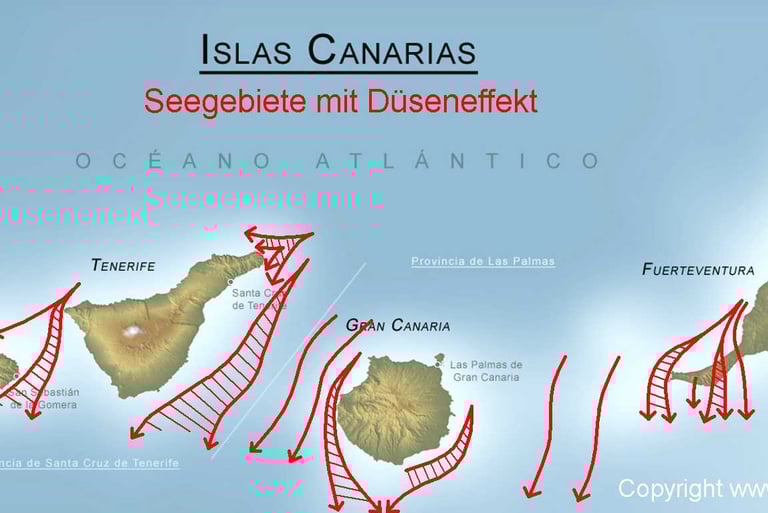
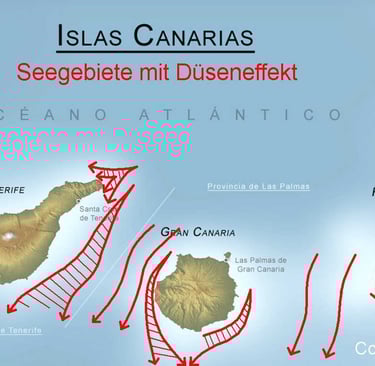
Copyright: esys.org
I arrive at the Amarilla San Miguel marina the next afternoon. Nothing like the well-developed marinas in the Mediterranean. Here we find a supply shop for maritime necessities, the harbour office in a beautiful building, otherwise the charter acceptance is handled from container offices.
Contrary to the planned handover at 1 p.m., we are informed that the pre-crew has given our yacht a real battering and caused some damage. Particularly bitter: the boom has probably hit the shroud during a patent jibe and is badly dented. There is no other option for the prevailing wind conditions in the Canary Islands: the boom has to be replaced.
So the safety and boat briefing can take place in peace and in detail. We were particularly concerned with how to get out of the box in strong crosswinds without running into the boats lined up far too closely opposite and not running the risk of drifting onto the neighbouring boat's protruding anchor.
Sunday morning is the day. The harbour of San Sebastian on La Gomera is to be our first port of call. However, the enquiry email from the previous evening was rejected in the morning - the harbour is full. A little perplexity sets in. The marinas are by no means plentiful, and with almost 30 knots of wind and high waves, anchoring in the middle of the Atlantic is not a good idea. I stroll round the jetties again and speak to the other charter crews. One of them tells me that she has a reservation for this harbour, but cancelled it 10 minutes ago by email. I quickly call the harbour office and can hardly believe it. We are actually given this berth. Now let's get going!
Start of the cruise
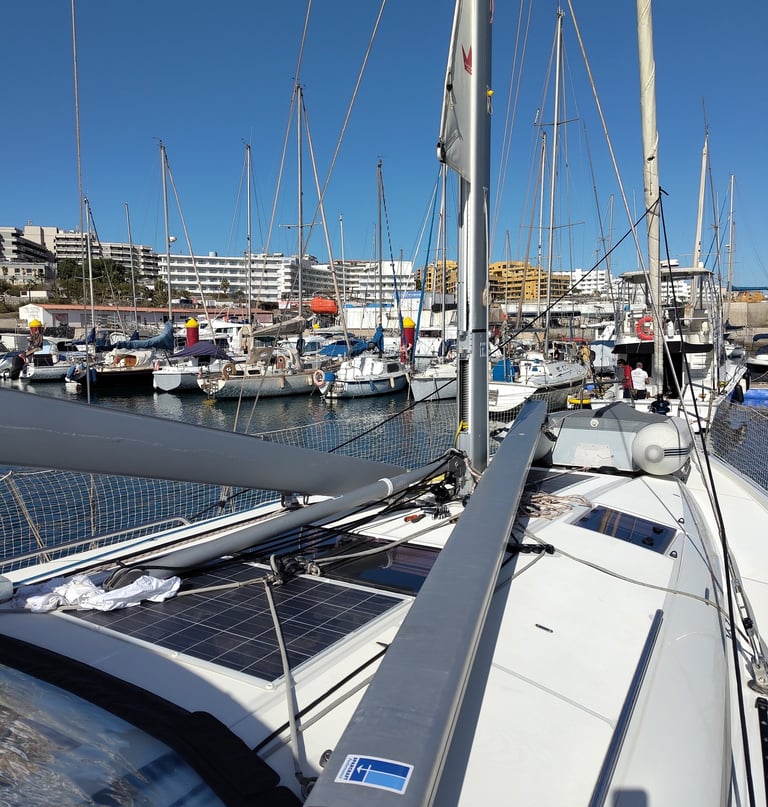
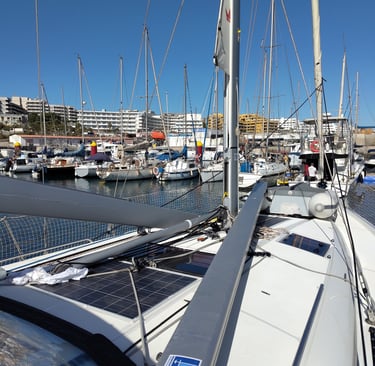
The twenty knots in the harbour, which Florian masters confidently when leaving, become thirty after leaving the harbour. It's interesting how many thoughts and options you consider when casting off and how easy the process actually is. In the Mediterranean, in these conditions, beginner crews are asked to stay and try to start the next day. Here, however, these are completely normal conditions and the crew consists of advanced sailors. We want to drift around the edge of southern Tenerife with the genoa clearly reefed, as the wind is coming from astern. We are well aware that this is not the best decision for the rig.
After 20 minutes of a good ride, it calms down, the main is used and the genoa is allowed to unfurl. Sailing like this is wonderful for a while. However, the notorious jet and cape effects around the Canaries soon show us what they are capable of. And the waves are also very choppy. No-one on board who doesn't feel at least a little unwell.
The reefing keyboard is played with virtuosity, with gusts over 30 knots reef 1 is no longer sufficient. The coupling of the expected distance proves once again to be inadequate, for me these are only theoretical values anyway, actually you can almost always add a few nautical miles on top if you want to complete your journey under sail. Shortly before La Gomera it's really choppy again and we're on the cross, how could it have been otherwise? Reading wind directions on Windy is becoming more and more pointless in this area and can only give you a very rough idea of what to expect.
Finally the harbour is in sight, the sails are hoisted and Harbour Control is radioed on channel 12. The entrance should be cleared in advance, as some catamaran ferries also dock and depart here. Of course, we are asked to wait, as a ferry is about to leave. Meanwhile, the crew men practise the behaviour of our SOD 440 under engine power.
After clearance, we sail through the buoys designed for pleasure craft to the harbour entrance. It's always fascinating that some charter captains enter the harbour without looking at the harbour handbook. While we are waiting for the marineros to assign us our place, a charter yacht comes sailing in from the side and discusses with us the obligation to give way. That this yacht should never have been allowed to enter the harbour and should have waited outside for the marineros, who had given us permission to enter shortly before - what the hell. After a safe and confident harbour manoeuvre, the "Free Elli" is safely in her box and it's time to go ashore. San Sebastian is a nice little town with catering facilities, we look for a restaurant and then go to bed early. The crossing was not without its problems, there are no distractions in the sense of clubs or bars in San Sebastian.
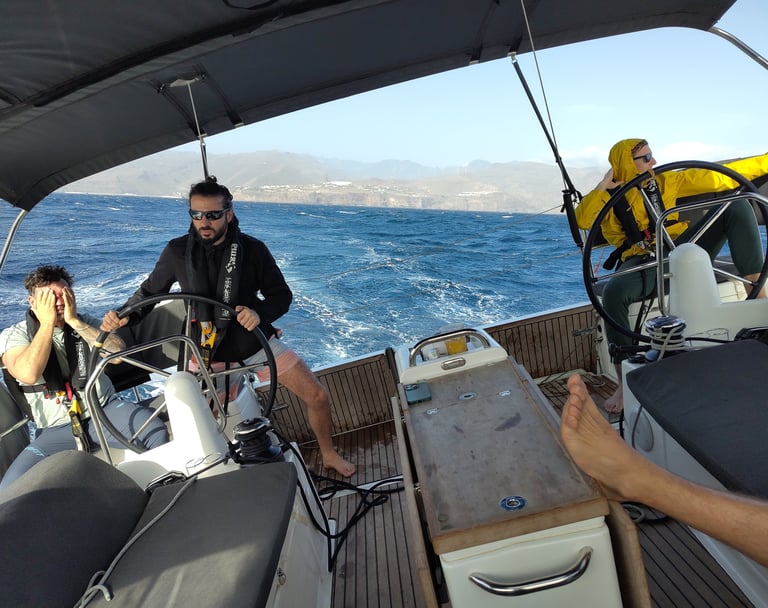
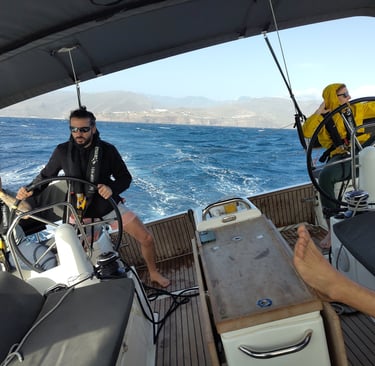
The following day, our thoughts return to what our next destination will be. The wind is still blowing strongly from the north-east, at least the Azores High is quite stable, so we can adjust to this wind direction for the whole week. My suggestion of putting in twenty nautical miles more than the day before and heading for La Palma is rejected. It already looks strong on Windy, but a half-wind course would have brought us to our destination quickly. Going back to Tenerife also makes no sense, so the harbour office asks if we can stay a day longer. This is possible, so we do the paperwork (beware, this can take half an hour!) and then take a trip to the southern tip of La Gomera and back.
The same game on Tuesday morning. Where to go? Marina Colon is fully booked, Garachico is also a little further away, so the choice falls on Las Galletas. The harbour is perhaps 3 nm away from our starting point, but then you don't have to look at the map and just think that you can discover a new harbour.
Encounters between Tenerife and La Gomera
The crossing begins excitingly again. There is hardly any wind behind the harbour, an experienced-looking owner's boat just ahead of us has reefed very clearly and only after 5 minutes we are forced to adjust our setup again,
It's incredible how quickly a breeze can turn into a strong wind here. After a few minutes, everything is fine and we head for Tenerife. The side waves give us a good shake until a small breaker puts our boat under water in the best of moods.
Finn had the worst position on board and was able to take a blue water shower. I'm always surprised that the saltwater tablets in the lifejackets don't work in this amount of water. The wave certainly caused a lot of laughter.
After an hour, the ideal sailing conditions are over. We start to feel Tenerife's land cover, pack up and start the engine. After a while, a rubber dinghy with lots of guests on board bobs in front of us. Where are they looking? Oh!!! Dolphins! It's a whale-watching boat.
I don't believe in driving straight at the animals, you should respect their habitat, which we take up far too much anyway. The two animals move further and further away from the dinghy and... indeed! They slowly approach us. We quickly realise that they are not dolphins, but two large pilot whales. What a sublime sight to see them surfacing again and again.
It becomes almost kitschy when one of the whales swims alongside us next to the boat and exchanges air. So close that you could almost think you could touch them. We watch in awe as they slowly glide away towards the north.
The wind picks up again, making the desired harbour manoeuvres a real challenge. Maik has to balance the "Free Elli" through the marina for some time because the yacht in front of us is hanging crosswise on the mooring and has completely messed up the manoeuvre. Until this knot is untied, we can still let a few jet skis and other yachts pass.
Finally it's our turn, we are moored to the mooring lines with our usual aplomb. My helpful comments are always met with "yes yes". I'll probably have to think about why that is :-).
I can no longer avoid it on Wednesday. The first night at anchor has been planned and confirmed by everyone. We'll see exactly where we end up, according to Navily there are several options on the south-west coast of Tenerife. As we approached the harbour, I could already see the high cliffs of our destination and had to change my initial assessment of "you can't anchor here" to "this is a great place to anchor". Let's see how well I manage that.
The bay I'm aiming for is listed in the guide as not open between February and August due to breeding birds. Mid-February is also February, I think to myself. A local told me that this was because there used to be a fish farm in front of the rocks that attracted a lot of birds. This farm no longer exists and the birds have moved to other places and this restriction no longer exists. Or rather, they want to change this again. Be that as it may, near the last place before the imposing rock faces, which is not called Los Gigantes for nothing, there are already two ships anchored, so we head for them. Both are quite far out, so there's still room behind them.
My calculations as to how long the line should be for the anchor marker fender were rendered absurd by our - or rather my - indecision as to where to drop the anchor. The result was as follows: We were far enough away from the other two yachts, and we were well below the 200 metre distance from the coast that should be maintained as far as possible in Tenerife. Even though the 8 metres of water depth at which we came to a halt was ideal. What's even worse is that the anchor fender is repeatedly completely sunk by the swell. If we imagine that the buoyancy of the fender only slightly hinders the lying of the buried anchor at best, it becomes clear that it can't stay that way. It's actually hilarious: What a messed-up anchor.
Re-anchored, the sling line significantly extended, and then the search for a better spot. Meanwhile, our two anchor neighbours decided to leave the spot. Good decision, I wouldn't risk having to spend the night next to us either. When the anchor drops and everything meets expectations this time, we have the bay to ourselves. Even the water bowline, which I haven't used for four months, works on the first attempt and takes the strain off our anchor chain on the yacht's bow cleat. It also goes without saying that the full, rising moon watches over us.
You really must drop anchor here too
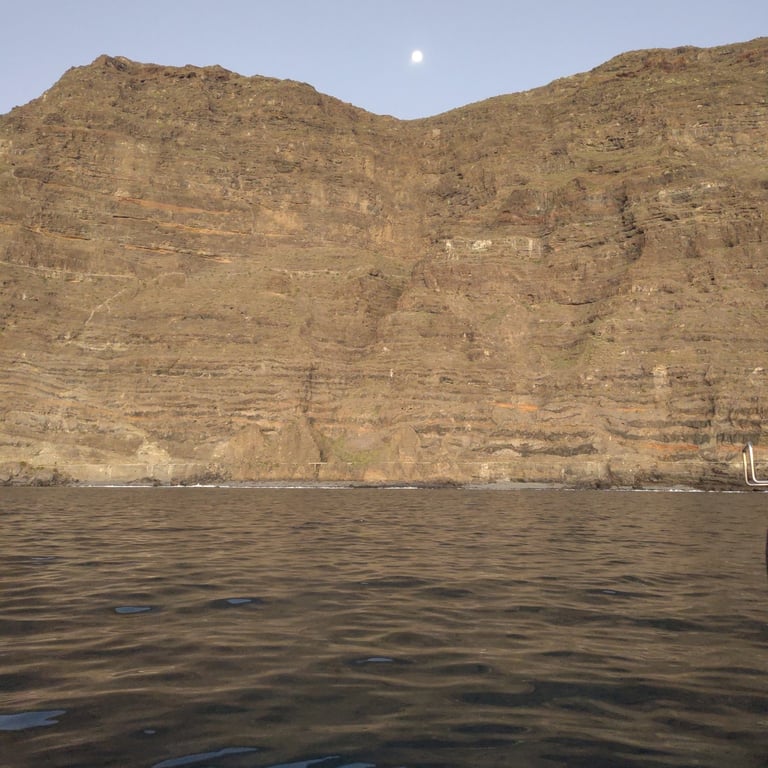
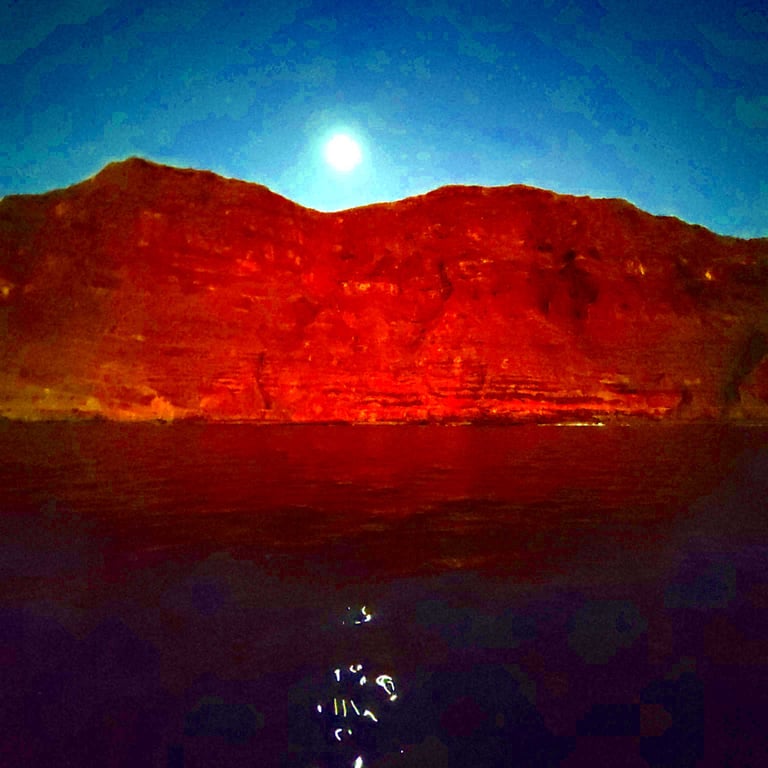
Speaking of watches: no wind, very light current, very light swell... A perfect night at anchor. And yet I barely manage to close my eyes for 20 minutes. How is the boat positioned here? With the stern close to the anchor fender, we have long since left the position with the bow to the anchor and the chain slightly tensioned. So we've turned round and are still held by the chain in front of the anchor. I hadn't seen it like this before either, and it always makes me wonder whether the sling line could be threaded somewhere.
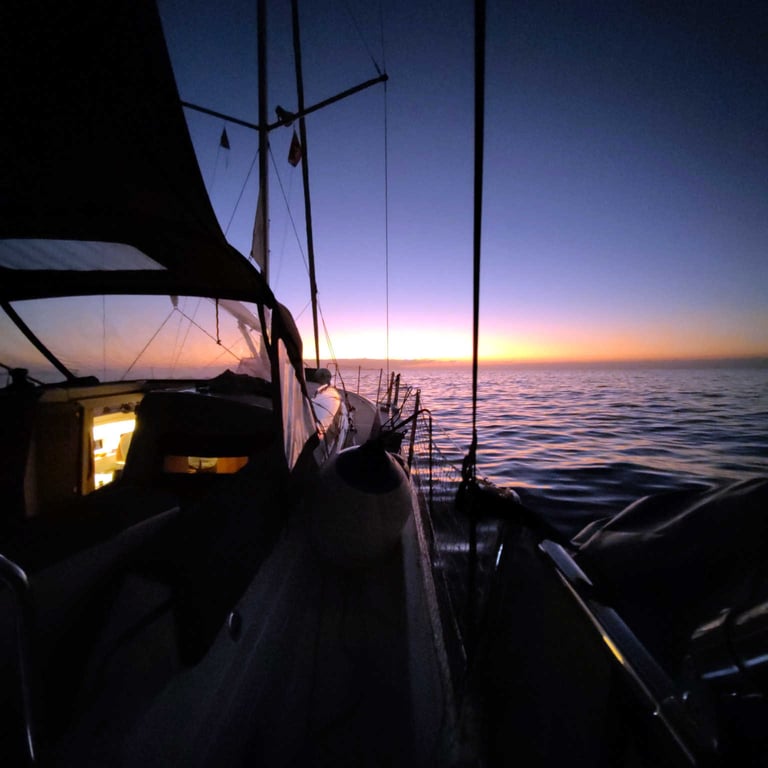
On Thursday, the plan is to really let it rip again. Santa Cruz de Tenerife and the associated 50 nautical miles, almost 30 of them against wind and waves, are to be completed. The crew is once again in party mode after the quiet, secluded night. The anchor is raised in the dark and we set off into the sunrise. At a similar spot (we have travelled up and down the south-west coast a little), creatures are once again cavorting in the water. This time it's actually dolphins. And what a number! There must be 30 to 40 of them, sometimes playing with our boat, sometimes near the neighbouring yacht. It's exciting that we wanted to get closer to them by lowering the bathing platform (bathing with dolphins is prohibited in the Canary Islands, by the way), but the beeping of the platform being lowered caused all the dolphins to turn their backs on us. So that was nothing. But they didn't hold a grudge and came back to accompany the yacht.
We then went into the water again for a swim. We laid a line with fenders and I asked my heroes not to take the current and the gliding of the boat lightly. Nevertheless, I'm always happy when everyone is back on board.
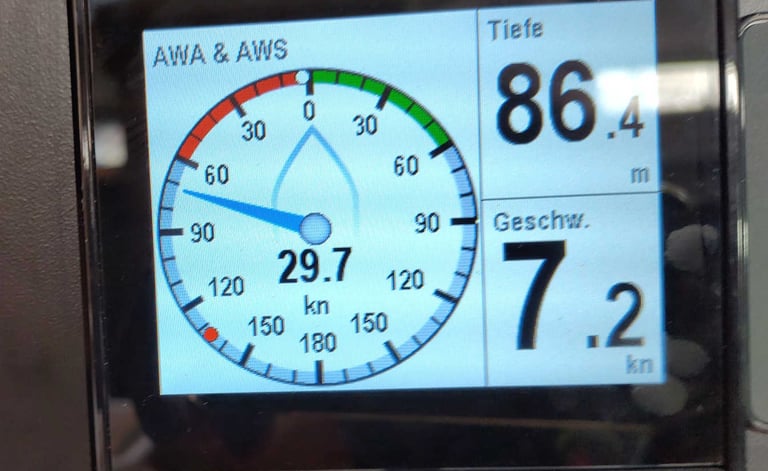
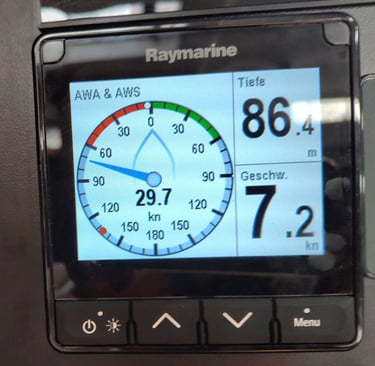
On the south-east side, it got really rough again. Looking at the weather forecast and realising that not everything is always forecast to be as bad as it could be makes my face crease with worry. Even if we reach Santa Cruz, won't it be too heavy tomorrow? After all, it's 30 nautical miles back. And I no longer trust gusts of 35 knots on Windy either. What if it's ten knots more again? Do you really have to put up with that? At the height of Montaña Roja, which rises 171 metres into the air, the wind and waves become so strong and accelerated again that I have to express my doubts. After some brief deliberation, we decide to abandon the trip and return to our home marina.
Now that we're no longer bumping into things, we can set sail and enjoy the afternoon. What can I say - as soon as we were a little further away from the coast and the aforementioned effects, it became a pleasant trip. Did I pull the line too early?
As expected, running into our box was unpleasant. I try to avoid using the bow thruster, as I smilingly told our charter company when we took over the yacht. No! You have to use the bow thruster!!! Yes, that's fine.
As I was finally allowed to do a manoeuvre, I was really looking forward to it. With the stern in the best possible position, I realised in the gusts that I should press the button before we lost our position. That worked well, but they wanted to tie the bow even closer to the jetty, against the wind. I was cheered on to use the bow thruster - I would have been thrown out in other marinas. But admittedly. Here, it's not just a pleasant but dispensable gimmick, you actually need it for this unpleasant berth that you've been allocated by the charter company.
We included harbour manoeuvres in the programme for the next day. The expected wind didn't materialise. Everyone thought it would really get going later, and our neighbour Jose tied the lines to us because he didn't want us on his boat. But nothing came at all.
Fine, then we'll practise according to my favourite saying "low speed, low damage". The fact that 3 other ships are practising mooring and casting off manoeuvres provides the necessary concentration and challenge. Or was it even a test? Wearing life jackets in 1 bft winds certainly indicated that. Yes - in Denmark we always wear life jackets in the harbour. But not in Spain...
Shortly after lunchtime, however, the promised wind arrived. After an unsuccessful approach and I had the feeling that the men were coming up with more and more unusual manoeuvres, I was able to influence them to finish the event before anything else broke. Finn moves our yacht astern, but slips to port twice. That can't be right, let me have a go. Stopped, the boat lies as I had imagined, now travelling slowly backwards... And I'm also slipping to port. Finn has managed to do the same and I have to meekly retract my instructive remarks.
Of course, the manoeuvres are challenging in the wind and you learn a lot - but I've heard the word "learning effect" used a lot before and didn't want to overuse it. Dennis wants to carry out the complicated mooring manoeuvre and gently places our yacht in his box. The lines are lashed down and our Free Elli can sway in the swell of the harbour and the gusts. So a challenging but also really exciting week came to an end.
Contact
Write me
+49-162-5401120
© 2026. All rights reserved.
Social links? No Facebook, no X, no Instagram. These platforms have no place in my world.

Google Ads and Google Analytics free site!