



Cape Verde
My arrival at Amílcar Cabral Airport on Sal has been delayed until one o’clock in the morning. Naturally, I don’t have the required visa to hand, but that can easily be sorted out upon arrival. However, finding a taxi is proving difficult. The taxi drivers of the few available vehicles pounce on the tourists wanting to travel to Santa Maria in the south; none of them seem to know my destination near the airport. No wonder, given that the fare for the journey to the tourist castle is more than three times the standard rate. So there I am, suddenly standing alone by the roadside. My internet isn’t working, and the officer won’t let me go back into the arrivals hall, which has open Wi-Fi. A brilliant start. Until, at last, an arriving taxi driver takes pity on me. It only takes a few minutes to get to my accommodation, Nifa House in Espargos, for 10 euros (if I can pay in euros, why on earth did I exchange my money for Cape Verdean escudos in Lisbon, paying an outrageous commission?). Despite it being the middle of the night, Valdemiro gave me an incredibly warm welcome, showed me around the place and even gave me a few tips. I was so grateful for his help and support that I think I’ll leave a review online.
Prologue - getting there
Once I'm reasonably rested, a taxi organised by Valdemiro takes me to Palmeira, twice as far away, for half the price. This is the charter base where I am allowed to pick up our yacht Alboran Prosecco. A well-known skipper, who had travelled on the boat two weeks earlier, gave me a list of all the major and minor defects and shortcomings. I probably wouldn't have taken over the boat in the Mediterranean. But we are in Africa. And we're only travelling just under 100 nautical miles across the open Atlantic to one of our destinations. And my SKS is not really sufficient for this trip. But everything else is fine on the Andrea Doria.
Alex and Katha from our crew are already in the harbour. The Prosecco is moored at a mooring buoy in the middle of the harbour basin. It's a completely different experience to be taken to the ship in a taxi boat. I was quickly familiarised with the motto of Cape Verde: No stress.
You won't be happy here with German punctuality. But as sensible German tourists, we don't expect life here to be like ours. I admit that it took me a while to get used to it.
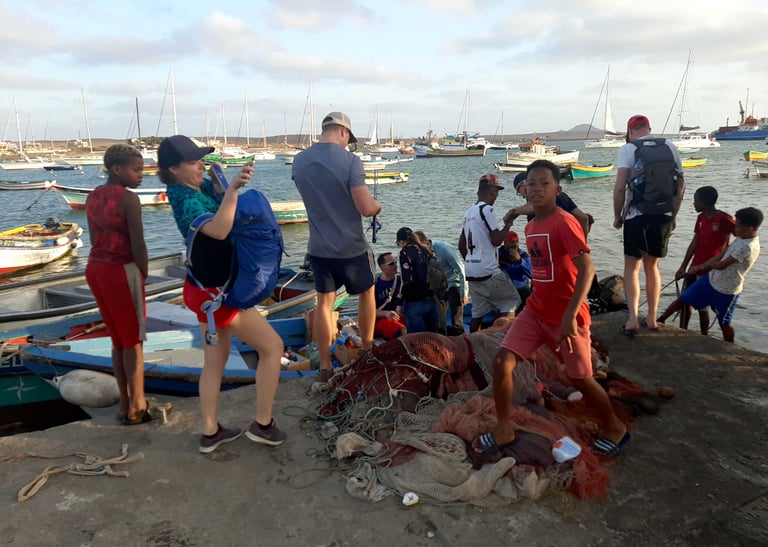
The next morning I am allowed to go to the Policia Maritim to collect the boat's papers and clear it out. This procedure has to be carried out on each of the nine inhabited islands of Cape Verde. A completely new experience for me as an EU citizen. Sometime around lunchtime, the time has come: some more fuel and water supplies have been - well, not topped up, but the two gauges are now over 50 per cent.
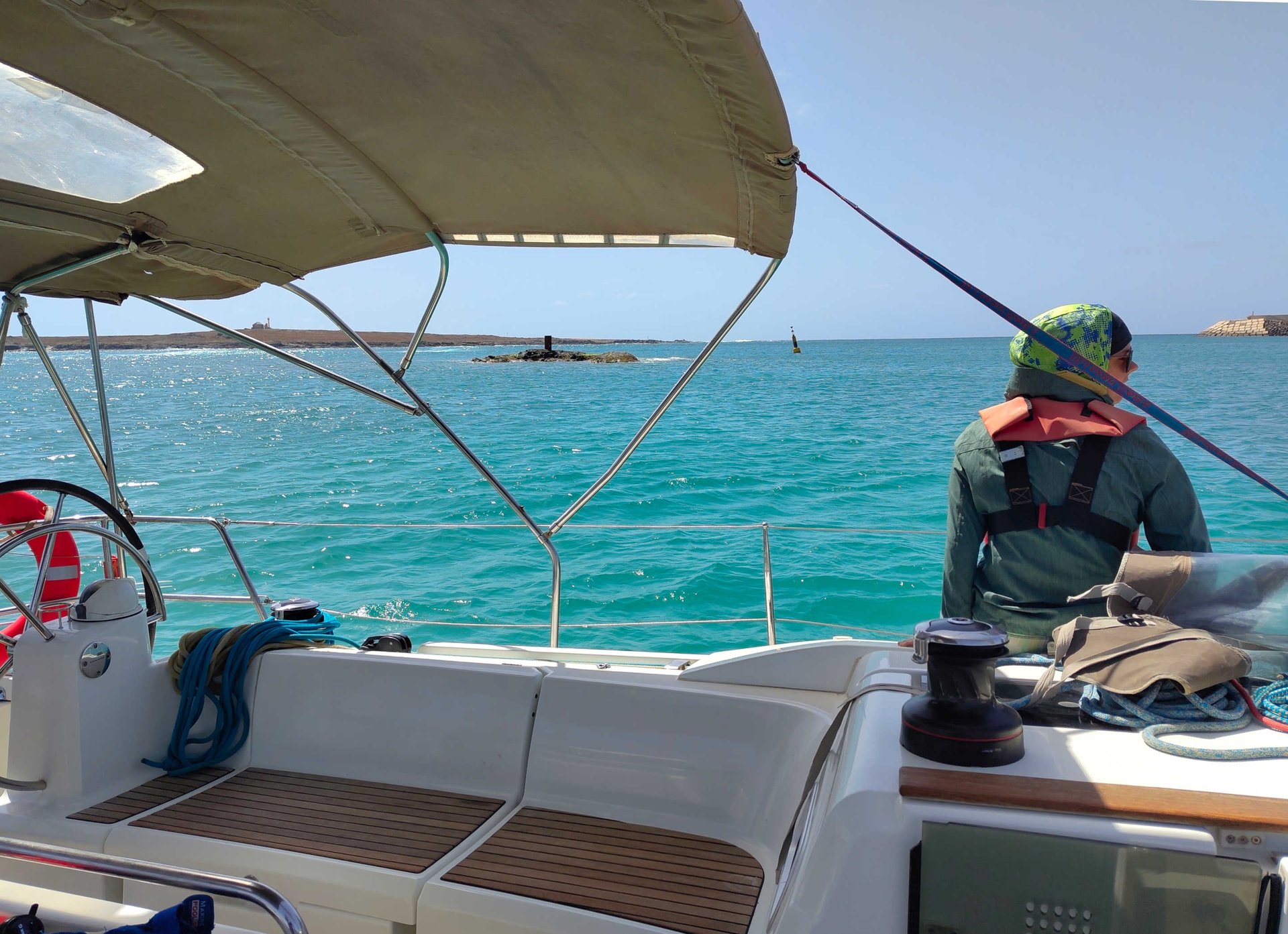
We untie the mooring line from the buoy and motor out of the harbour. We look carefully for the concrete blocks lying seemingly at random in the fairway. Once we have mastered this passage, it is time to set sail for the first time. One of the yacht's shortcomings is the lack of the first two mast slides on the sail head. As mentioned, I took over the yacht in africa style. The lack of a bilge pump, an only partially functioning chart plotter and other limitations would be unacceptable in other areas. But we were not promised any repairs - should I ask the crew to go on shore leave without having achieved anything? I can't deny a certain excitement, stronger than usual.
For the first night, we chose an anchorage in the south of Sal so that we could familiarise ourselves with the boat and our seamanship. A quick look at the southern tip near Santa Maria showed us an impressive swell and breakers on the beach. We settled down in the calmer spot, not really protected from the wind, at Ponta Preta. Towards the beach, the kiters were having fun, but the stiff breeze was a bit too much for me to anchor. But we experienced completely different wind forces, so first arrive and enjoy.
Our destination for the next day is the island of Boa Vista. Shortly before casting off, we spot orcas at sea. First the typical whale blowing, i.e. the water fountain, then a brief surfacing and we see the typical white clouds on the whales' skin. Even if you treat these animals with respect, especially as a sailor, I would have liked to see them from a closer distance.
The wind direction (which blows mainly from the north-northeast in Cape Verde) favours our trip to Boa Vista and the harbour of Sal Rei. We have reserved a buoy there. The harbour entrance is exciting, with shoals and an impressive surf close to our berth right across our harbour, but we grab the two mooring lines and are safely moored. After a while, we are brought ashore and immerse ourselves in the African way of life for the first time.
Set sail into the unknown
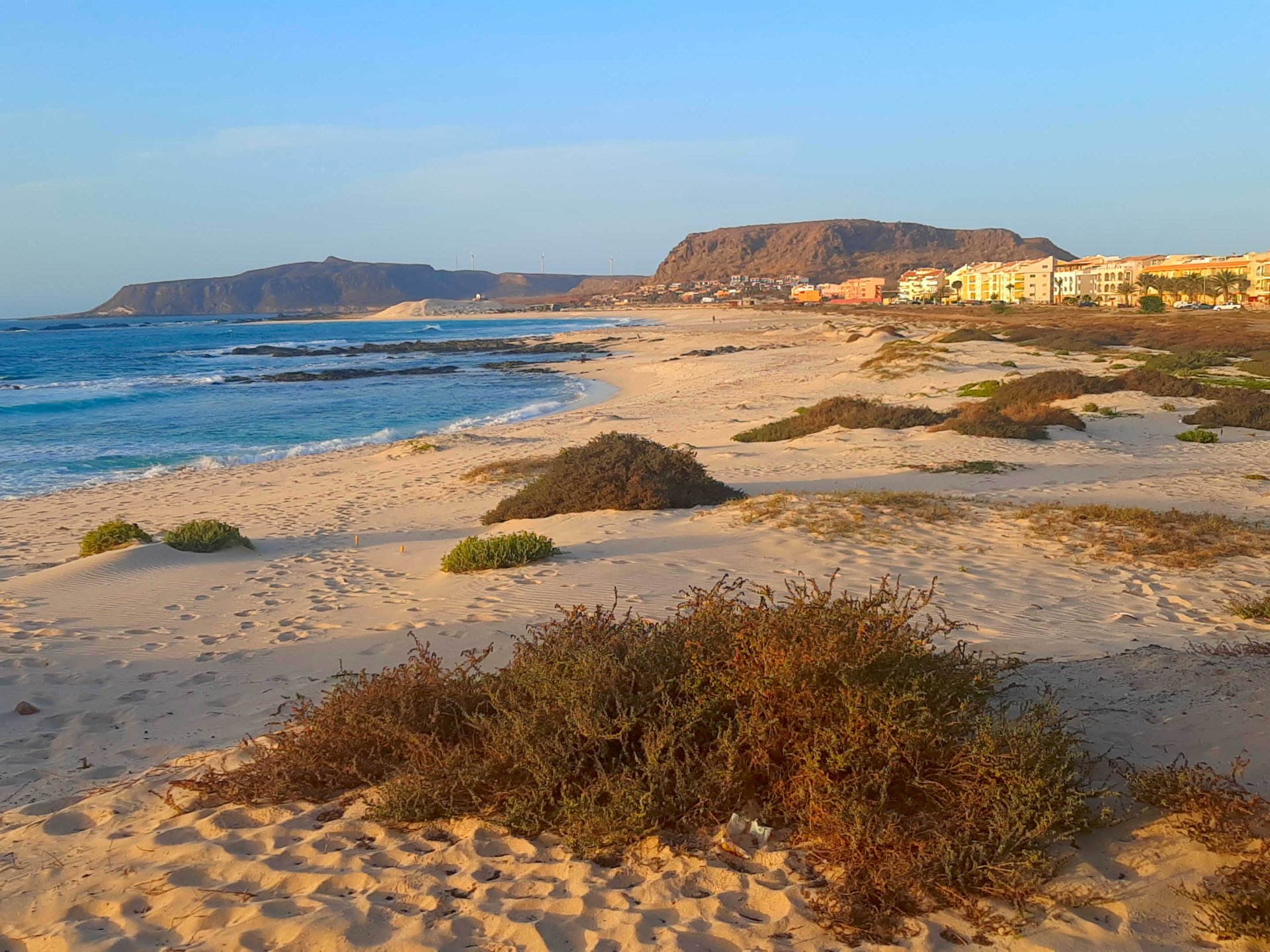
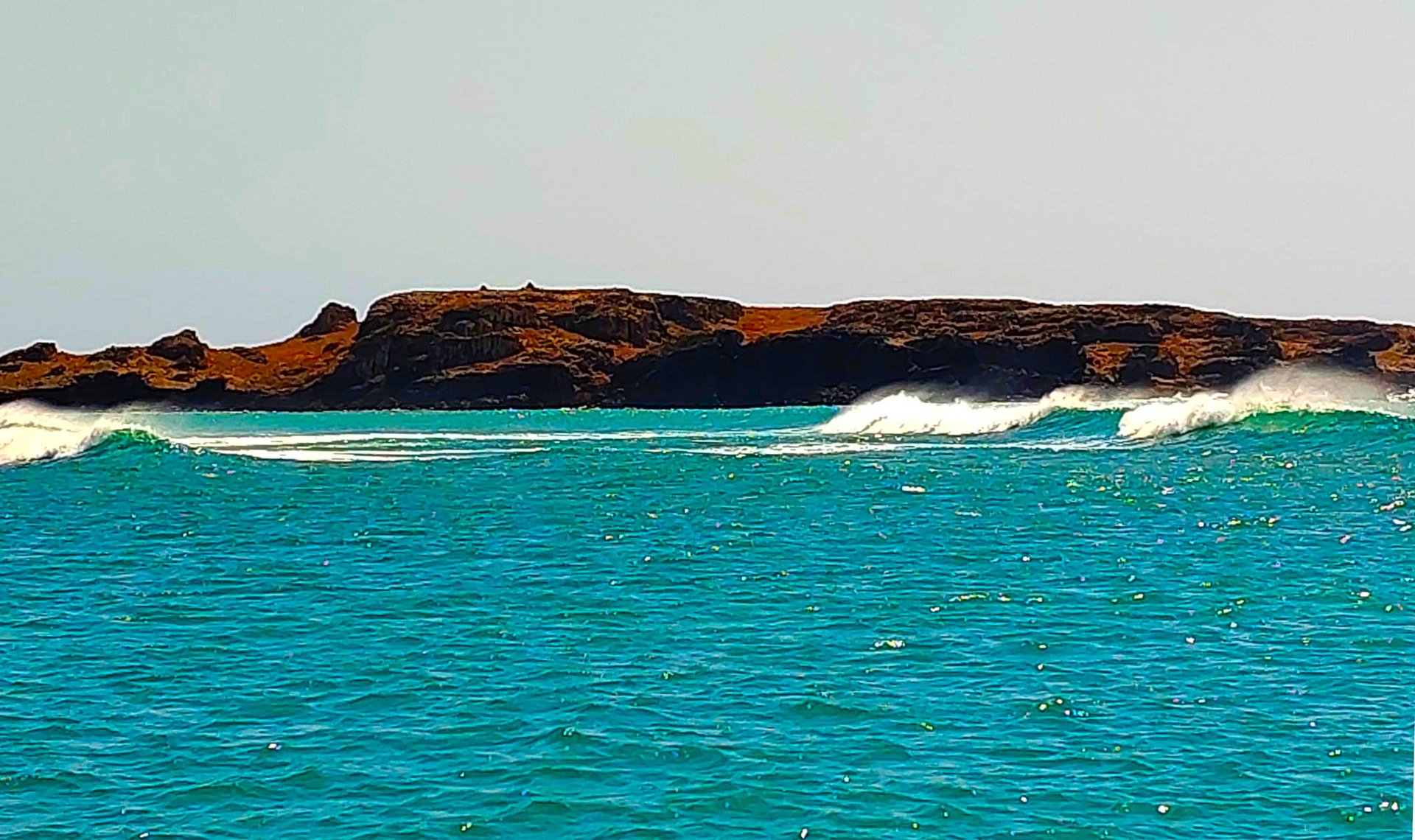
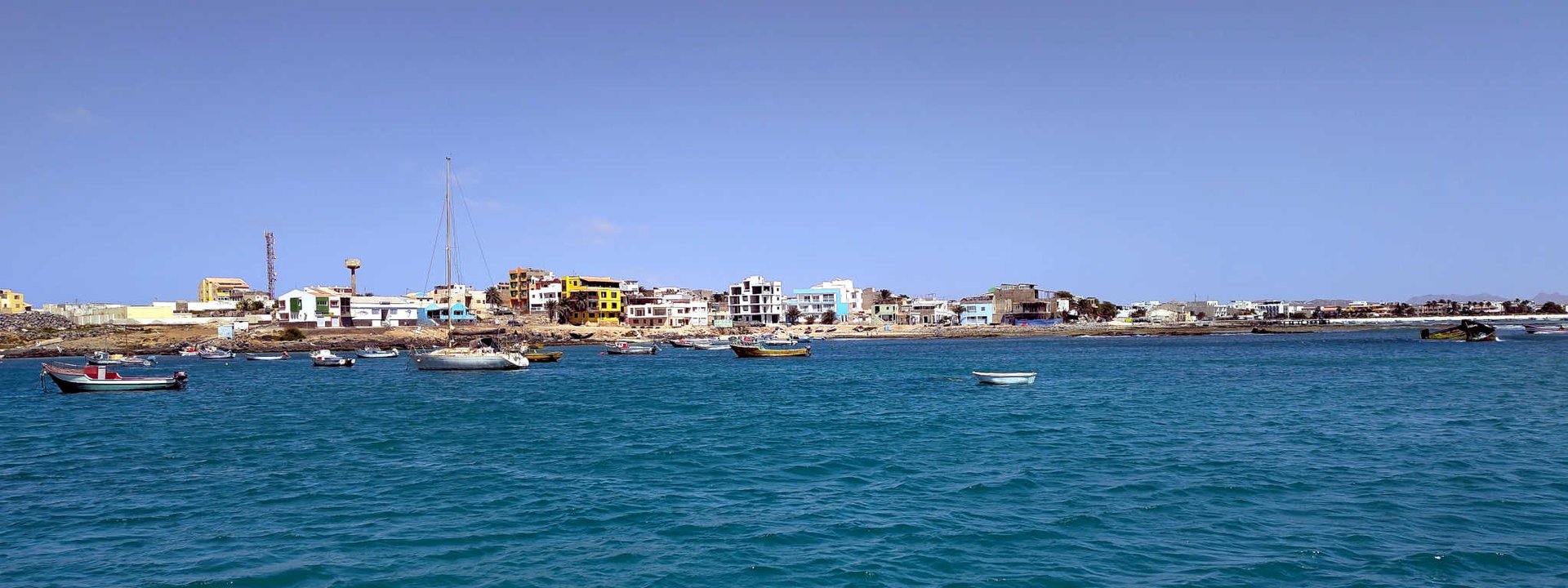
My attempt to clear in is hindered by the fact that nobody knows where the Policia Maritim actually is. Late in the evening, after a great dinner at the Sodade Casa da Cultura (Sodade is a Cape Verdean word that describes a complex emotional state of longing. It is also expressed in the music, the morna) we then made our way through the town to the police station. They were delighted with my documents and wished me a good holiday. So not clearing in after all? Probably not that important then.
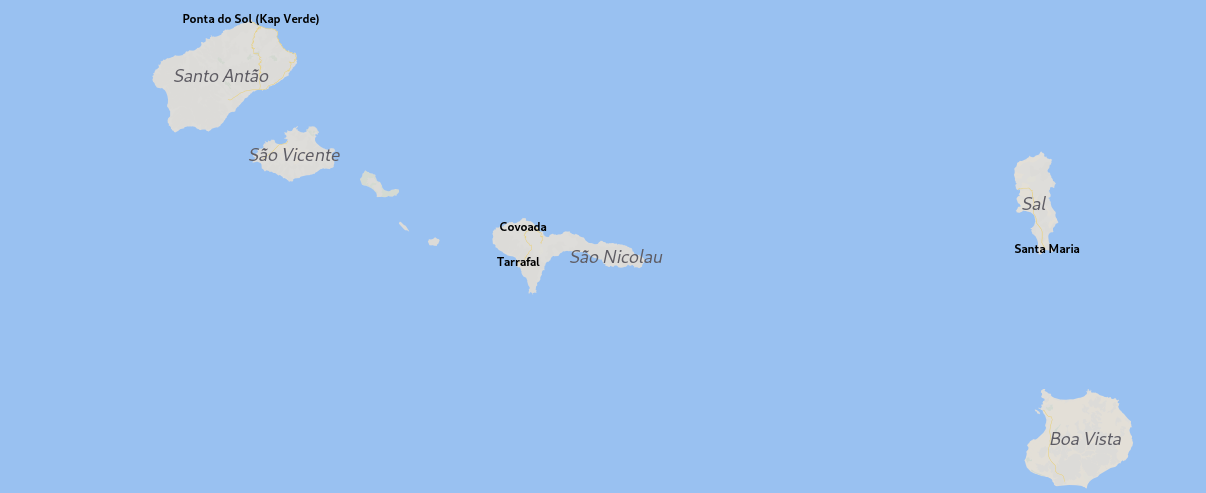
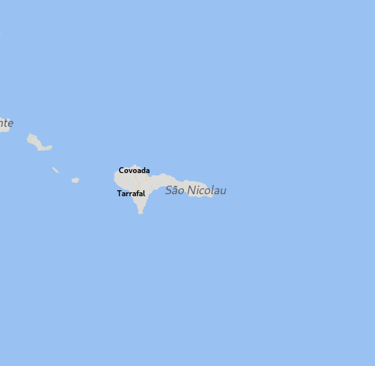
We have a long stretch ahead of us today and get ready early. We have to reach Mindelo on São Vincente on time at the end of the week for a crew change, but we are aiming for an anchor stop on the island of São Nicolau. Between 80 and 90 nautical miles are on the programme. The wind from the north-east suits our course perfectly. There is probably no better way to cover this distance.
The wind picks up a little in the evening. I had actually decided to anchor off the harbour wall of Preguiça. Pedro Álvares Cabral is said to have set sail from here with his fleet to discover Brazil by chance. We prefer not to dwell on the fact that a ship from his fleet was lost somewhere here for unknown reasons.
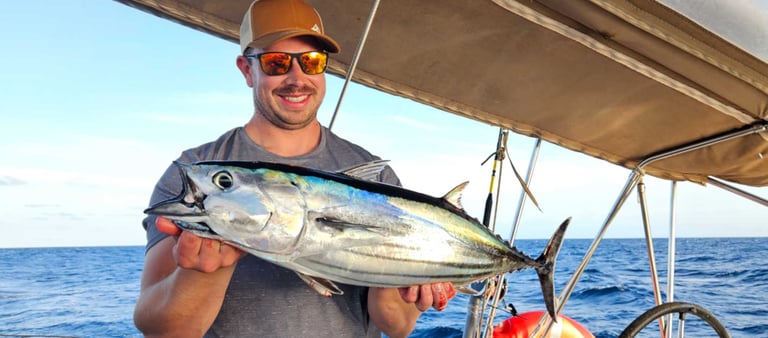
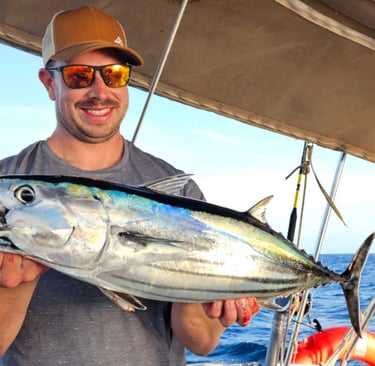
Before selecting the anchorage, Alex has his big moment. His trolling rods have been dragged through the water for hours, but nothing more than a plastic bag has been caught. And now he has a big bonito on the hook. We will feed on this fish for three days.
According to the Navily entries, there is a more suitable anchorage north-east of Preguiça, so we change our mind shortly beforehand. We can't inspect the anchorage, it's far too dark for that, so we speculate a little and are lucky: the first cast is right and we have a perfect hold. After the exhausting crossing, we end the evening in a cosy atmosphere with deliciously prepared fish.
The long journey to the north-western islands
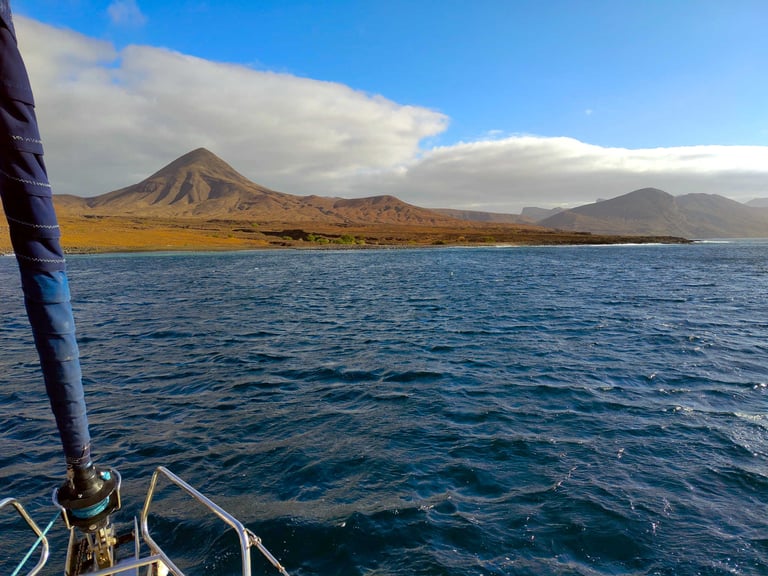
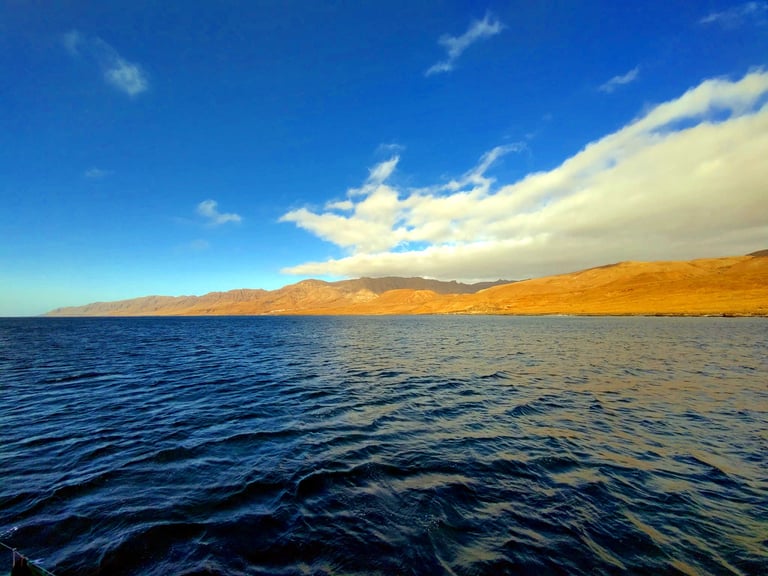
Somewhat euphorically, the next morning I suggest rounding the island of São Nicolau on the north side and heading for our next destination, Santa Luzia. I have suggested a distance of 50 nautical miles without calculating this properly. We would have to cover a considerable distance first in an easterly direction, from where we had travelled the day before, turn up the east side and then sail west to Santa Luzia. After 5 nautical miles, we hadn't even completed half of the easterly course when something very unusual happened to us: A short lull. All of this costs us an enormous amount of time, as does tacking, so that what was supposed to be a leisurely trip turns into a proper, time-consuming beat. As we sail down the northern side of São Nicolaus, still with modest wind conditions, it becomes clear that my calculations are not working out.
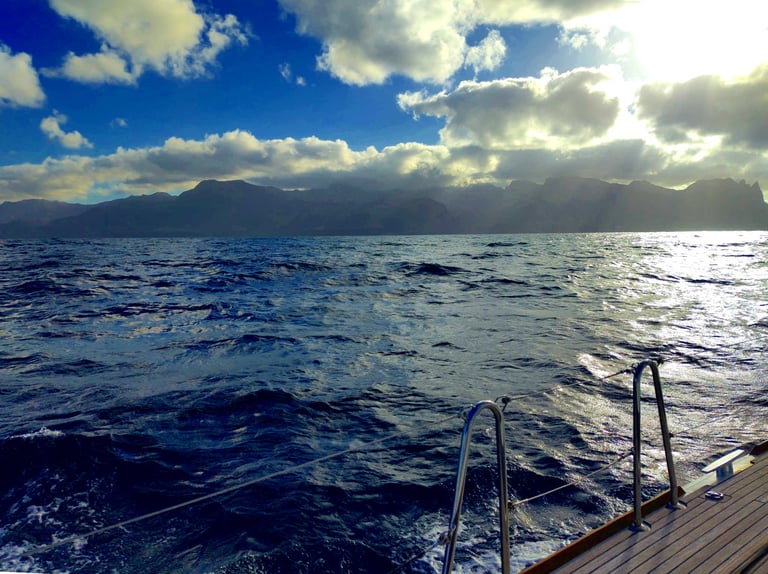
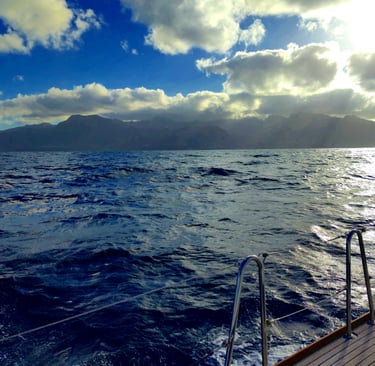
So what to do... Back down to the south side of Nicolau and to Tarrafal? This is the shortest option, but the route tomorrow will be all the longer. So, after a lengthy discussion, we decide on an anchorage in the supposed shelter of Ilhéu Branco. At the western end of São Nicolau, the wind picks up considerably and we should cover the last 10 nautical miles quickly. The sun sets and the wind picks up more and more. There we have our 6 Beaufort again with a few gusts. We have to pass the shallow passage between Ilhéu Branco and Ilhéu Razo on an astern course. At this point, the sea bed rises from 2,000 metres to just 20 metres. This is clearly noticeable in the wave crests, which David has to surf with concentration.
An unforgettable night
There's quite a lot going on behind us, perhaps it's better that it's already pitch dark and we can't see how rough the sea is. In the meantime, we are back to 7 Beaufort throughout. Once we have left the narrowest part behind us, things calm down a little. Our anchorage seems to be protected by the island, which is over 300 metres high, and again the anchor grabs reliably after the first attempt, but again we can't see what kind of ground we're working on. I decide to spend the night in the cockpit.
That goes quite well at first, but I realise what powerful gusts are shaking our yacht. So I quickly attach a mooring line for the anchor chain and its strain relief for the anchor winch.
As I only operate the anchor windlass with the engine running - the voltage display on the battery was more puzzling than safe due to its erratic readings - I make a bit of noise. And half the crew are on their feet to help. That wasn't my intention, of course, but it shows excellent seamanship!
After an hour, our bimini starts to disintegrate. The plastic viewing windows, which contrary to their name no longer offered any visibility at all, tear. Flapp... it folds away completely, revealing the view of the sky again for the first time. Magical - a shooting star flies past the horizon at this very moment. This is only spoilt by the fact that I don't get hold of one of the two viewing windows in time and it disappears into the ocean. As if there wasn't enough plastic floating in our oceans already, this definitely puts me in a bad mood.
A bang, again the creaking of the anchor bracket, that doesn't sound good. The mooring line is actually still attached to the cleat, but is hanging in the water. The gusts are pulling so hard on the boat that it has snapped. So I try again, put in some more chain (this time only Alex was watching, the others must have guessed that I would repeat the manoeuvre) and lay back down. The anemometer shows an average wind of just under 20 knots, but there is hardly any movement on the display in the brutal gusts. Either they only develop directly above the surface of the water or our anemometer is not playing ball. As I stand on the bow again, I am blown two steps backwards. I'm sure that the peak of the gust will reach 40 knots.
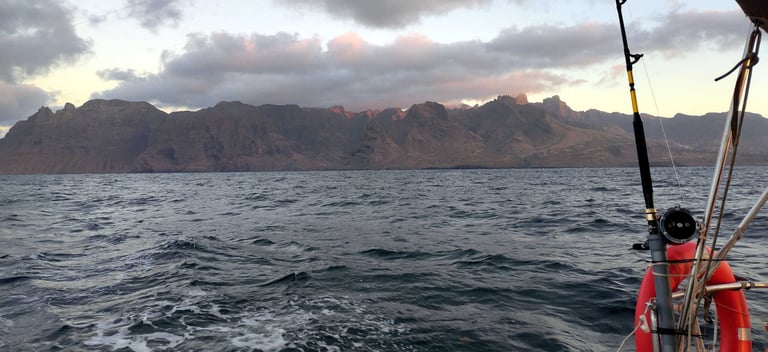
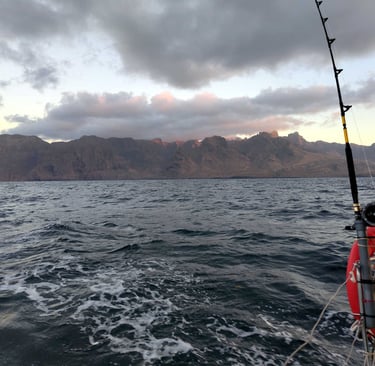
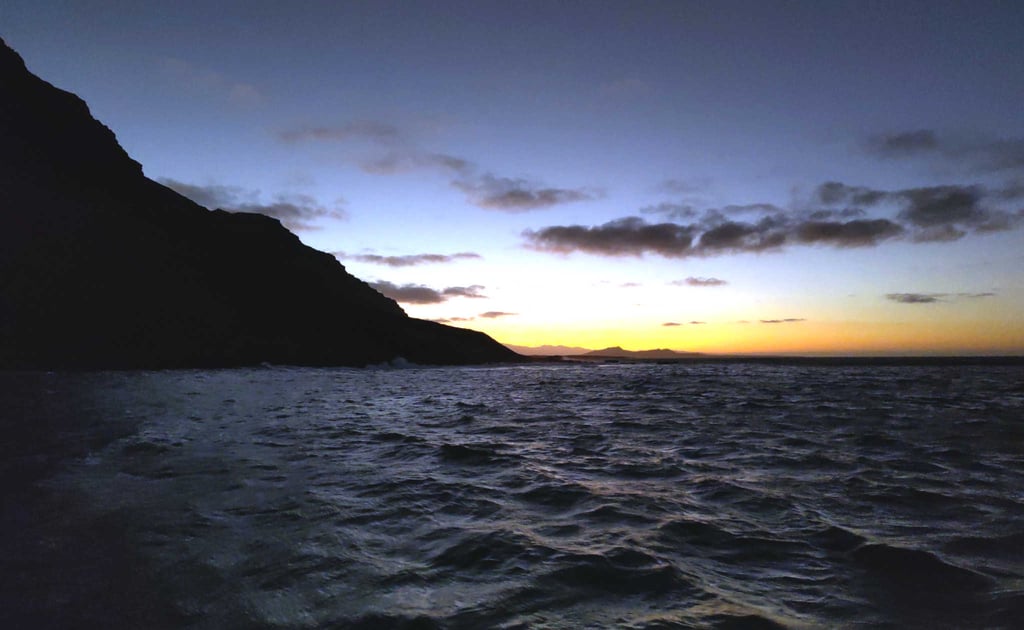
After a sleepless night in which the anchor alarm didn't go off and we were actually still in the same position, the crew woke up. The wind finally dies down a little as the sun rises. I hit the bunk for another half hour, but it's not much help for my need for sleep. After the next leg of the journey, it's time to moor up in the marina, the only one in Cape Verde so far.
We head for our destination at a good speed, a half-wind course that accelerates our SY Prosecco considerably. Much faster than expected, we sail along the south side of São Vincente to the strait between this island and Santo Antão. We can already see the white foam peaks that dress the waves in this strait. And after a short break in the wind, we really get going, heading in the opposite direction.
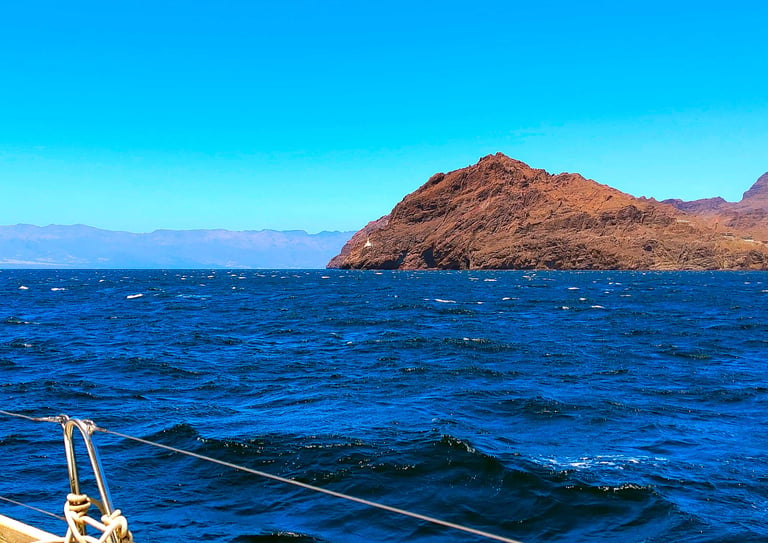
Shortly before the coast of Santo Antão, we have almost reached the height of the entrance to Mindelo. We had to initiate a turn and then head for our destination if possible. But that doesn't work at all. We actually sail back again. Reef 2 was probably still too much, and the current was shifting us strongly to the south. After the wind and waves become borderline, we decide to request engine assistance. Otherwise the 2 nautical miles would have been considerably longer.
Although I was told that I didn't need to radio the marina, I put on channel 72 and got an answer. We were still far too far away and I should call back before the harbour. We are met there by a small motorboat and Stephan moors our yacht after correcting the intended berth. Originally, our bow was supposed to be facing into the wind, which would have been tricky without the use of a bow thruster. Our marinero redirected us straight away after I shouted this to him. A very friendly welcome, and the radio call is also recommended, although not always successful.
Contact
Write me
+49-162-5401120
© 2026. All rights reserved.
Social links? No Facebook, no X, no Instagram. These platforms have no place in my world.

Google Ads and Google Analytics free site!